

Silver Needle White Tea
Description
Silver Needle White tea (Yin Zhen) Buy Online
Silver needle tea (Bai Hao Yin Zhen, Silver Needle) is considered the finest white tea. The best qualities of the silver needle tea come from Fuding, Fujian in China.
Special feature of the silver needle tea
Silver needle white tea has always been considered the noblest and therefore also the most expensive type of white tea. The best "Bai Hao Yin Zhen" are among the 10 top teas in China and worldwide. Only tender, unopened buds are picked in spring for this white tea. No other type of tea only uses buds.
These are obtained from a special tea bush variety of the Camellia Sinensis tea plant. These are the best qualities from the southeast Chinese province of Fujian, the two best cultivars "Fuding Da Bai" and "Fuding Da Hao" as well as Fu’An Da Bai.
Because of the special tea variety, the use of delicate buds and minimal processing, the silver needle tea has an incomparably elegant and delicate taste like no other tea variety. Its infusion color is also incomparably clear and almost inconspicuous, depending on the location and the tea, from jade green to light yellow.
Bai Hao Yin Zhen - silver pin in Chinese
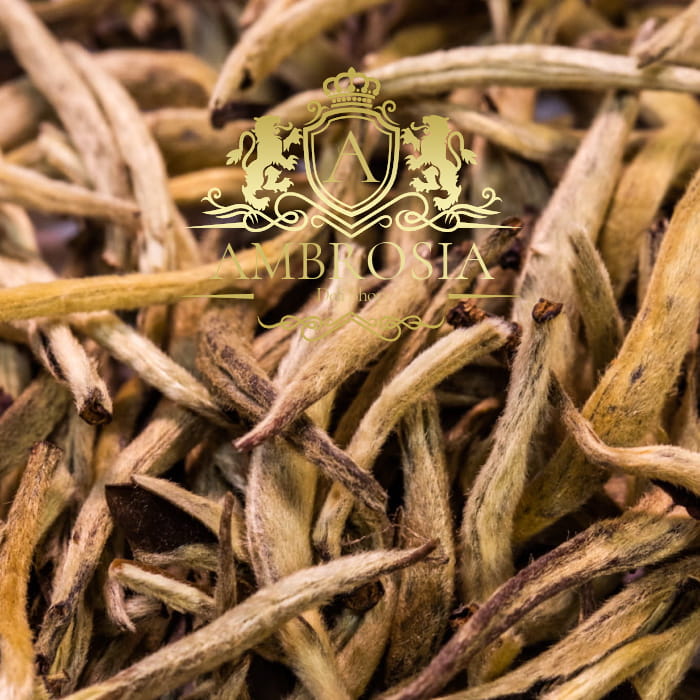
The silver needle white tea got its name because of the numerous fine, white or silver hairs on the buds, which give it a beautiful silvery appearance. In English it is called "Silver Needle Tea". Silver needle tea, which is made from the traditional Da Bai tea bush or the best Da Bai and Da Hao varieties, is called “白毫 銀針” in Chinese (Pinyin: bái háo yin zhēn, English: “White Hair Silver Needle” or sometimes also “White Fuzz Silver Needle”). Translated directly, 白 bái means white, 毫 háo: fine hair and 銀針 yin zhēn: silver needle.
Preparation of silver needle white tea
Depending on the quality, the silver needle tea is prepared differently. The best teas can be poured over with water at only 70 ° C. Medium grades are prepared at 75 ° C and less good grades at 80 ° C. The same applies to the steeping time: for the best teas, only 3 minutes of steeping time is sufficient, while the medium-sized teas should steep for around 4 minutes and the less good teas for around 5 minutes. For a serving of tea, about 1 to 2 very heaped tablespoons of silver needle tea should be used for about 200 to 300ml of water, depending on your taste. In principle, you shouldn't skimp on the dosage.
The best teapot for preparation: Yixing
Traditionally, silver needle tea is prepared in three different ways. Often the tea is only poured into a tall glass so that one can watch the buds moving up and down and the formation of a small "bamboo forest". The gaiwan (zong), a small porcelain vessel, is also popular for fine qualities in smaller quantities. Both of the aforementioned methods lead to a neutral, unaffected taste and aroma.
By using a Yixing teapot made of natural, high-quality clay, an improvement in taste is achieved. The tea is much more expressive and aromatic. The Yixing teapot should ideally consist of a purple "Zishi tone" (Zini - Purple Zishi). This reacts positively with the water and the ingredients of the tea leaves and gives the infusion an even better taste.
Aged silver needle white tea
If stored appropriately, it can age over many years and thus gain a different composition of active ingredients and taste. Such teas are traded at high prices in China and are also used for medicinal purposes. It is advisable to infuse silver needle tea with a ripening age of around 5 years at a significantly higher temperature (around 90 ° C) and let it steep for around 10 minutes.
Highest quality and effect of all white teas
Silver needle tea has the highest quality and general effect of all white teas. Only less than 0.1% of China's total tea production is grown by it. The health effects of silver needle tea are generally very valuable and of outstanding importance for certain diseases. This is especially true for silver needle tea that has been matured for several years. It is traded for very high prices in China and traditionally also regarded as an effective medicine.
Best growing regions and varieties for silver needle white tea
The Silver Needle originally comes from the Fuding region of the Chinese province of Fujian. See the history of white tea. She has always been known for the very special qualities of silver needle tea (fuding silver needle). Its subtropical climate with mild winters, hilly mountains, lots of sun, large temperature differences between day and night and the fertile soils form an ideal prerequisite for the sophisticated “Da Bai” variety of white tea. Within Fudings, the locations around Mount Taimu (900m) are considered to be particularly good. The silver needle tea is said to have been originally discovered here. The Taimu Silver Needle teas are therefore considered to be of the very best quality in the world.
In addition to Fuding, the Zhenghe, Jianyang and Songxi regions in Fujian should also be mentioned. Fuding in the northeastern part of Fujian is by far the largest and best producer. Zenghe is traditionally the second best region, but produces relatively little silver needle tea and mainly Pai Mu Tan tea. Neighboring Chinese regions are also growing the Silver Needle in larger quantities. Particularly noteworthy are the aromatic qualities from the southwest Chinese province of Yunnan.
Only Fuding and Zenghe grow the best cultivars.
Outside of China, silver needle tea is also grown in relatively small quantities in Sri Lanka and Darjeeling (India), but here somewhat different tea plant varieties are used or slightly different forms are produced. Overall, the quality is not as good as that of Chinese teas, even if considerable progress has been made here.
Beware of fakes
Due to the large price differences, it happens again and again that silver needle teas from less good regions are mixed with the tea from Fuding, or are even labeled completely incorrectly. Such counterfeits are sometimes difficult to detect for the non-tea professional. In any case, buyers should only buy their silver needle tea from a trusted dealer. The information on the packaging should provide detailed information about the exact origin, quality, picking date and tea variety. It is best to buy the tea from a trader who imports it directly from the tea farm, maintains a personal relationship and knows the producer's quality standards.
The cultivars for white tea
Authentic silver needle tea comes from the seeds of the tea tree family of the so-called Da Bai (Da-bai cha-shu; bai = white). You can recognize the top quality by the use of only the best leaf buds. These are particularly bright, covered with fine white hair and springy. This tea should only contain buds and no leaves or even stems.
At upscale tea farms in Fuding, the best region for silver needles, the two varieties (cultivar) Fuding Da Bai and Fuding Da Hao are mainly used. In contrast to the Fuding Da Hao, the Fuding Da Bai has smaller buds and leaves. Therefore, many tea farms have switched to growing Da Hao for reasons of profit. However, the smaller and firmer Fuding Da Bai results in a slightly more intense taste.
Hand picking and differences in quality in the silver needle
The best silver needle teas are handpicked with particular care. This is extremely important for the quality of silver needle tea, as the buds are hardly processed any further and remain natural. Even small damage or cracks on the buds start the process of oxidation and convert the ingredients. Machine picking is much cheaper and faster, but does not offer acceptable quality for the requirements of silver needle tea. In addition, only the best buds can be selected by hand picking.
With silver needle tea, as with all other types of tea, there are also very large differences in quality within its group. You can recognize the best silver needle tea optically by the degree of intactness of the pure buds, the consistently bright, beautiful color and the silvery white down on the buds.
The best qualities have the following external characteristics:
- Only tender, unopened buds,
- Integrity of the buds,
- No other parts of the plant: leaves or even stems,
- Jade green with silvery fine hair,
... and arise from the following factors:
- from a quality tea farm in the Fuding or Zheng He region, Fujian Province, China,
- only the best, intact, tender buds of the cultivars Fuding Da Bai, Da Hao or Fu’an Da Bai,
- 100% pure varietal and varietal,
- Hand picking, sun drying, only low temperatures when drying the interior,
- Suitable weather on the day of harvest (sun drying) and before harvest (sufficient rain and sun),
- traditional processing (drying on bamboo baskets, no baking, etc.).
Infused tea buds reveal a lot about quality
The infused buds of the silver needle tea reveal more about the quality of the tea than the not yet brewed tea. With green tea, on the other hand, the opposite is true. When brewed, the buds of the white tea show their shape, integrity, color and thus their quality more clearly. Less good qualities do not stay light green, but are yellow or even slightly brownish. If you pick up the tea, it should feel thin, very soft and elastic.
Color of the yin zhen infusion
The silver needle tea shows a very transparent, particularly clear and ideally very beautiful jade green, almond or apricot to light yellow color in the infusion.
The elegant silver needle taste
The best silver needle tea has a particularly delicate, elegant and slightly sweet taste, without astringency. The taste is unique and difficult to describe. It is reminiscent of the finest notes of a Japanese gyokuro together with a hint of goji berries and fresh flower blossoms. The sweetness lingers for a relatively long time in the aftertaste, along with a fresh, flowery green note. This corresponds particularly to the silver needle teas from Fuding, Fujian. The teas from Yunnan, on the other hand, taste much more full-bodied, a little less elegant, but with a greater expression.
Silver needle tea has a very accessible taste and, in contrast to most green teas, is perceived as very tasty even by tea beginners.
Elaborate harvest of silver needle tea
The harvest is carried out in spring while the buds are still unopened and have not yet been able to develop into leaves. Usually the earliest harvest takes place on a day to a week before and after the Qingming festival (usually April 4th or 5th).
The weather is decisive for the choice of the day. It is important to find the best time so that the buds are not too underdeveloped or too developed. In addition, it cannot rain or be cold on the day of harvest. The best harvest time is on a sunny day in the morning when the sun has already developed a little strength to drive the moisture off the leaves.
The tender buds are plucked along with the small stem on which they grow. These are carefully removed by hand only after the harvest has been brought into the tea farm in order to avoid any damage. The careful way of picking means that even good pickers can only harvest around 500g of buds per day (!). From this amount only 100g silver needle tea is made.
The special demands on the weather, the tedious hand-picking of only tender buds and the necessary careful handling of them make harvesting the silver needle teas a very time-consuming and cost-intensive undertaking. So it is not surprising that the best silver needle tea is significantly more expensive than inferior quality white tea, such as Pai Mu Tan (White Peony) or even Gong Mei and Shou Mei. The buds and young leaves left over from the silver needle tea are used for Pai Mu Tan. For the other varieties, only the older, coarser leaves are used.
Silver Needle is the most natural of all teas
After the harvest, the silver needle teas are simply dried and subjected to a relatively short wilting process. Ideally, drying takes place in the sun. Often, however, drying machines are also used, especially in bad weather, or in poor quality with larger quantities.
Compared to all other types of tea, the processing of white tea is the shortest. The tea is only exposed to a low level of non-enzymatic oxidation and, overall, remains the most natural or least processed. After the drying process, it is usually packed warm and airtight so that the buds absorb the humidity contained in the packaging. As a result, the buds stay more supple in the packaging and do not run the risk of breaking, which would have very negative consequences for their aroma and active ingredients. Good silver needle tea will ripen in the packaging and even gain flavor.
Storage of silver needle tea
Airtightly welded in original packaging, good quality silver needle tea can be stored and matured for years if it is kept cool enough. It will gain in quality in the sense of a completely different character.
After opening the packaging, it will keep its quality for a few months if it is kept in a suitable tea caddy or in an air-protected bag with a zipper. The tea should never be exposed to light, odors or heat and should not be stored in the refrigerator.
Japanese lacquered tea caddies made of particularly hard wood (e.g. zelkove) achieve the best events. But the best of all are Japanese tea caddies made from cherry wood bark. The tea stays in them for a long time and even gains a good deal of taste and effect in the first few weeks. You only buy such fine pieces once - they last a lifetime and just keep getting better.
Where does white tea come from?
White tea is the essence of delicate elegance and simplicity. Its minimalism is reflected in the production process - young buds and leaves are collected with great concentration so as not to accidentally damage their structure, and then left in the sun. The result is a product with a subtle, refined flavor profile, rich in fresh floral notes and fruity sweetness. It is an ideal infusion for the early hours of the morning, it has a calming effect and can accompany the slow preparations for the hustle and bustle of the day.
The motherland of white tea is China, although it is now also produced in smaller quantities in other parts of Asia. As I mentioned at the very beginning, the process of leaf processing consists of only two steps - harvesting and drying. This makes white tea the least processed type of all made from Camellia Sinensis Sinensis. You can follow the process here:
You have certainly noticed that white tea is much more difficult to meet - indeed its share in production is relatively small compared to green and black tea. As a result, this variety is (not always rightly) considered the most expensive and the most exclusive. Its elusiveness fosters many myths about the alleged intricacies and pitfalls of the brewing process. Or maybe they are the reasons why we are less eager to reach for white teas? It's time to change that!
Properties of white tea
Is white tea healthy? It is said that among the types of tea, white tea is the healthiest because it is the least processed. It is a rich source of antioxidants, thus inhibiting the aging process of the skin. White tea relieves tension and stress. Thanks to the flavonoids contained in it, i.e. organic chemical compounds, it prevents cardiovascular diseases. It is also the source of C.
Brewing and flavor notes
We've probably all heard that white tea is extremely sensitive to the brewing temperature - one false step and the leaves will be burnt, wasted and battered! In fact, however, white tea not only tolerates, but also likes, high temperatures, close to the boiling point, which release more aromatic compounds from it. Do not worry, start brewing the leaves at 90-95 degrees Celsius - maybe a higher temperature will discover a new richness of your tea flavors? Start with 2 teaspoons of tea per 200 ml of infused water for 3 minutes.
The brewing process can be an extremely relaxing and calming ritual. Take a few minutes to look at the dry leaves. White tea is characterized by delicate, white and silver leaves, sometimes covered with soft hairs, and the resulting thick infusion will have a light, honey color. The taste is dominated by sweetness - if you do not like the bitterness present in green tea, you will surely like its white version. The most noticeable are fruity and floral notes - melon, baked apples, pears, and butter, like cookies. We can also come across delicate herbal and even hay accents! There is a lot going on in the world of white tea.
Varieties of white tea
You should start your adventure with white tea with the most popular ones, incl. Yin Zhen (Silver Needle) and Bai Mu Dan (White Peony), preferably "pure" - flavored white teas are very popular due to their mild profile that does not interfere with other additives. However, I recommend that you try the leaves at the beginning and then experiment. Thanks to this, it will be easier for you to test the infusions and discover the perfect balance of flavors.
Let's start with Yin Zhen tea - the so-called A silver needle, which owes its poetic name to its white, slender, slightly fluffy buds. It is made mainly in Chinese provinces, its infusion is thick, even creamy, sweet, with notes of fresh fruit and accents of herbs and butter.
Bai Mu Dan, in turn, are the buds from which the Silver Needle is produced, and additionally larger leaves. The thick, syrup-like infusion conceals a variety of fruity and floral notes; Bai Mu Dan is eagerly combined with rose petals.
I would like to introduce you to one more variety of white tea - Ya Bao. This is a less known variety with an unconventional origin and, consequently, of taste. Ya Bao is made from shrubs that are usually used for black teas - from the beginnings of twigs (and not, as is the case with most teas, from leaf buds). Comparing the appearance of Ya Bao with traditional white teas, you will surely notice the difference, which is revealed in its unusual, slightly resinous aroma.
White tea is perfect for starting your adventure with tea - easier to brew, forgives a lot and does not shock you with its controversial taste. I encourage you to try and experiment - it will be an interesting experience to prepare cupping with the three varieties of white tea mentioned above and compare them at the same time.
Which white tea should you choose?
You should start your adventure with white tea with classic items, such as: teapigs Silver Tips White or Paper & Tea - Pu Er Bai Ya. When you get to know its aromas and get used to the unique taste, try unique proposals such as Or Tea - Lychee White Peony or Paper & Tea - Perfect Day.